|
 27.03.2021/
18:36 LT 27.03.2021/
18:36 LT
Palmer, Alaska, USA
Aviation Investigation Final Report - WPR21FA143
On
March 27, 2021, about 18:36 Alaska daylight time, an Airbus
Helicopters AS350-B3, N351SH, was substantially damaged when it
was involved in an accident near Palmer, Alaska.
The pilot and four passengers were fatally
injured, and one passenger was seriously injured. The
helicopter was operated under Title 14 Code of Federal Regulations (CFR)
Part 135 as an on-demand air charter flight.
The five killed in the crash were identified as
Gregory Harms, 52, of Colorado;
Petr Kellner, 56, and
Benjamin Larochaix,
50, both of the Czech Republic; and two Alaskans,
Sean McManamy, 38, of Girdwood, and the pilot,
Zachary Russell, 33, of
Anchorage.
The only survivor of the crash was identified by a Czech media outlet as
David Horvath, a 48-year-old Czech snowboarder.
A local lodge had contracted with the helicopter operator to transport
passengers from a private residence to a heli-ski area at a nearby
mountain. The surviving passenger stated that, before the last ski run
of the day, the pilot attempted to land on a ridgeline but that the
helicopter lifted off for an attempted second landing. The passenger
also stated that, during the second landing attempt, the snow was “real
light” but that the helicopter became “engulfed in a fog which made it
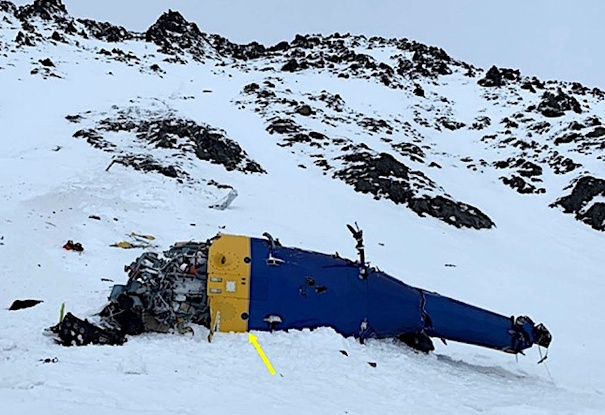
appear like a little white room.” The helicopter subsequently began
“going backward real fast” and impacted the ridgeline and rolled
backward down the mountain.
Postaccident examination of the airframe and engine revealed no
preimpact mechanical malfunctions or failures that would have precluded
normal operation of the helicopter. The passenger’s recollection of the
conditions just before the accident was consistent with whiteout
conditions caused by rotor wash while the helicopter was hovering near
the ridgeline. Thus, the pilot likely experienced whiteout conditions
during the second landing attempt, which caused him to lose visual
reference with the ridgeline and resulted in the helicopter impacting
terrain.
Title 14 Code of Federal Regulations Part 135 required flight-locating
for the helicopter in case it was overdue so that information about the
helicopter’s location could be reported to a Federal Aviation
Administration (FAA) or a search and rescue facility. The helicopter
operator stated that it had delegated the responsibility for
flight-locating to the local lodge. However, this delegation was not
documented in the company’s FAA operations specifications or general
operations manual, as required by Part 135.
On the day of the accident, the local lodge was providing
flight-following for the accident helicopter, which, unlike
flight-locating, was not required by Part 135. The helicopter was
expected to depart the heli-ski area for the principal operations base
once all the ski runs had been completed. The flight-follower informed
his supervisor that 40 minutes had elapsed since the helicopter moved
from its last recorded position and that there had been “no positive
comms” with the ski guide during the last 1.5 hours; this notification
was made 41 minutes after the last “ping” from the helicopter. However,
the remote area in which the accident flight was operating had limited
communication capabilities, and no clear evidence indicated that an
accident had occurred.
The flight-follower’s supervisor contacted another heli-ski company to
help determine the status of the helicopter. The heli-ski company
considered the flight to be “ops normal” and expected that the last lift
would occur shortly. The supervisor instructed the flight-follower to
“keep an eye on” the accident helicopter; however, the lodge’s emergency
response plan stated that a search and rescue facility should be
contacted “if communication with the helicopter is not established by
the end of the prearranged [time] or 30-minute grace period.” Therefore,
it would have been reasonable for the lodge to activate its emergency
response plan at this point given that the helicopter’s location was
unknown at the time.
The flight-follower continued to try to reach the helicopter but was
unsuccessful. About 90 minutes after the last flight-following “ping”
for the helicopter, the lodge received erroneous information from the
heli-ski operator that the accident helicopter was “inbound” for the
private residence; however, lodge personnel did not realize that this
information was not accurate and that the accident had occurred
immediately after the last ping. This incorrect information likely
played a role in the lodge’s further delay in activating its emergency
response plan.
About 1 hour and 50 minutes after the accident (and the last
flight-following ping), the heli-ski operator notified the accident
helicopter operator about the overdue aircraft. Five minutes later, the
lodge notified the helicopter operator that it was activating its
emergency response plan. About 2 hours after the accident occurred, the
helicopter operator activated its emergency response plan. About 17
minutes later, the helicopter operator notified the Alaska Rescue
Coordination Center. The director of operations for the helicopter
operator stated that the search and rescue notification did not occur
before that time because he had been “working through the information
that was provided” about the helicopter.
The helicopter wreckage was located about 3.5 hours after the accident.
Rescue personnel launched within 1 hour of notification and arrived on
scene less than 30 minutes later (about 5 hours 40 minutes after the
accident). The surviving passenger was transported via helicopter to a
local hospital. Upon arrival at the hospital, the surviving passenger
had hypothermia and severe frostbite. A shorter exposure to the cold
would likely have decreased the severity of the surviving passenger’s
injuries. However, a faster emergency response time (and thus shorter
exposure to the cold) could only have occurred if the notification to
search and rescue personnel had been timelier. Thus, because the lodge
and the helicopter operator did not activate their emergency response
plans sooner, the initiation of search and rescue operations was
delayed.
Given the circumstances of this accident, the investigation considered
three types of training that the pilot should have received: inadvertent
instrument meteorological conditions (IIMC) training; controlled flight
into terrain-avoidance (CFIT-A) training, during which instruction in
whiteout conditions would be conducted; and ridgeline training. Review
of the operator’s pilot training program showed that ridgeline training
was not provided for the make and model of the accident helicopter (or
the previous helicopter in which the accident pilot had been trained).
Further, IIMC training was a part of CFIT-A training, and the CFIT-A
manual stated that pilots were required to complete IIMC training
annually. However, the chief pilot for the helicopter operator stated
that the related test for pilots (to demonstrate understanding of the
subject) was only administered when a pilot was first hired, and the
director of operations stated that the company’s only IIMC flight
training involved recovery from unusual attitudes. In addition, review
of the accident pilot’s flight training records found that he completed
IIMC training 14 months before the accident (which was about 1 year
after he began working for the operator), but the records did not
reflect the specific IIMC training that the pilot received. Based upon
the information provided by the operator, it could not be determined if
the accident pilot had fulfilled the training requirement.
The director of operations reported that the helicopter operator did not
accomplish flight training as part of its CFIT-A training; however,
flight training was not required for that subject, and the pilot
received CFIT-A ground training. The CFIT-A manual stated that, if
inadvertent whiteout conditions were encountered, the pilot was to rely
on flight instruments and carefully attempt to maneuver the helicopter
away from obstacles and terrain.
Additional review of training records revealed that, during competency
checks, the helicopter operator was not evaluating several requirements
of 14 CFR 135.293, including recovery from IIMC, navigation, air traffic
control communication, and instrument approach flying. Paragraph (c) of
the regulation required a pilot to demonstrate the ability to maneuver
the helicopter into visual meteorological conditions after a simulated
encounter with IIMC, a skill that was needed during the accident flight.
The operator stated that it did not have any instrument-flight-rules
(IFR) aircraft capable of IFR approaches, but the GPS model installed on
the accident helicopter had IFR capabilities with instrument approach
procedures in its database. Thus, given the deficiencies in the
operator’s pilot training program and Part 135 checkrides, particularly
regarding IIMC, it is likely that the pilot did not meet the
qualification standards to be the pilot in-command of the accident
flight.
The FAA principal operations inspector (POI) for the operator failed to
ensure that the company’s operations specifications (specifically,
paragraph A008) contained the operational control information required
by 14 CFR 119.7 and 135.77. (Flight-locating was part of operational
control.) The company’s operations specifications did not describe who
would be responsible for the safe operation of company flights and how
those flights would be operated to meet requirements; thus, the
operations specifications were incomplete. Although the company should
have noticed this omission before the operational specifications were
signed, the POI was ultimately responsible for ensuring that the
operations specifications contained all the required information.
FAA Order 8900.1, paragraph 3-1255, discusses helicopter flight training
maneuvers that “must be conducted for satisfactory completion of each
category of flight training.” The order also stated that all helicopter
pilots operating under Part 135 “must be trained on procedures for the
avoidance and recovery from IIMC” and that inspectors were required to
ensure that operational procedures for recovery from IIMC are
incorporated into the certificate holder’s training curriculums. Thus,
the POI failed to ensure that the operator’s training program contained
all required elements, which also included ridgeline training, before
approving the training program. In addition, the POI was also unaware
that the operator was not conducting competency checks in accordance
with section 135.293(c) and that its checkrides were only assessing a
pilot’s recovery from unusual attitudes.
From 2011 to 2013, the POI was the chief pilot for the accident
operator; from 2001 to 2011, she worked at another helicopter company
with the person who later became the president of the accident operator.
The POI started her employment with the FAA in 2016 and, 2 years later,
became the POI for the accident operator. The available evidence for
this investigation was insufficient to determine whether the POI’s
previous employment history was a factor in the inadequate oversight of
the accident operator.
Toxicology testing of specimens from the senior lead ski guide
identified two central nervous system stimulant drugs: amphetamine and
cocaine. Given the drug levels measured in his blood, the senior lead
ski guide was likely impaired by drug effects at the time of the
accident. Toxicology testing of specimens from the other lead ski guide
identified delta-9tetrahydrocannabinol (THC), the primary psychoactive
component in cannabis. The low THC level measured in his blood indicates
that he was not likely experiencing significant impairment from THC
effects at the time of the accident. Although ski guides are not
considered crewmembers according to the Federal Aviation Regulations,
they have safety related responsibilities during heli-ski flights such
as coordinating with pilots about landing and pickup zones and assisting
pilots with hazard and pickup zone identification. However, the
investigation was unable to determine whether the senior lead guide’s
illicit drug use played a role in the accident.
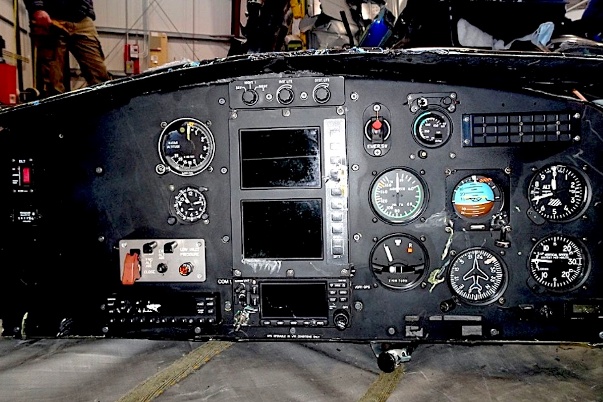
The accident helicopter’s instrument panel was
recovered virtually intact. It had a full set of flight instruments,
including attitude and directional indicators, altimeter and vertical
speed, airspeed and even a radar altimeter. The pilot should have been
able to transition to instruments long enough to escape the white-out
area.
An NTSB meteorologist determined that winds near the accident site at
6,000 ft. would have been out of the north at around 20 kt. This would
have resulted in downslope wind flow south of the mountain ridges in the
vicinity of the accident site, possibly accounting for the direction at
which the helicopter fell.
Probable Cause: The pilot’s failure to adequately
respond to an encounter with whiteout conditions, which resulted in the
helicopter’s collision with terrain. Contributing to the accident was
the (1) operator’s inadequate pilot training program and pilot
competency checks, which failed to evaluate pilot skill during an
encounter with inadvertent instrument meteorological conditions, and (2)
the Federal Aviation Administration principal operations inspector’s
insufficient oversight of the operator, including their approval of the
operator’s pilot training program without ensuring that it met
requirements. Contributing to the severity of the surviving passenger’s
injuries was the delayed notification of search and rescue
organizations.
========================================================================================================
 Последний
рейс Петра Келлнера. Что погубило самого богатого жителя Чехии? Последний
рейс Петра Келлнера. Что погубило самого богатого жителя Чехии?
 27.03.2021/ 18:36 м. вр. 27.03.2021/ 18:36 м. вр.
Ледник Кник, Аляска, США
Авиакатастрофа, произошедшая на Аляске
унесла жизнь самого богатого человека Чехии. 56-летний Петр Келлнер
погиб в результате крушения вертолета, на котором группа туристов
следовала на лыжную экскурсию.
Крушение произошло 27 марта, но сведения о
личностях тех, кто находился на борту, стали известны только сейчас.
Вертолет Airbus AS350 B3 вылетел на
экскурсию с горнолыжного курорта Tordrillo Mountain Lodge. На борту
находились Келлнер,
пилот Зак Рассел, гиды Грегори Хармс и Шон
Макманнани, турист Бенжамен Лароше, а
также еще один человек Давид Хорват.
О падении вертолета стало известно около
22:00 по местному времени 27 марта. ЧП произошло в районе ледника Кник.
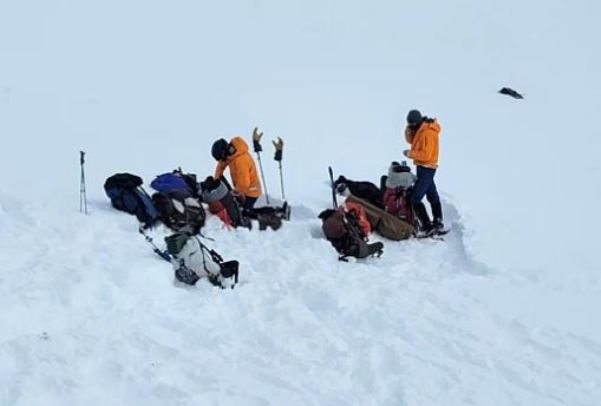
Спасатели, прибывшие в район крушения,
обнаружили одного выжившего - Давид Хорват. По словам медиков, человек
находился в тяжелом, но стабильном состоянии.
Пять его спутников, включая
Келлнера, арендовавшего вертолет, погибли.
Миллиардер часто отдыхал на Аляске. Он
увлекался хели-ски — разновидностью горнолыжного спорта, суть которого
заключается в спуске по нетронутым снежным склонам, вдалеке от
подготовленных трасс с подъёмом к началу спуска на вертолёте.
Спуски по диким склонам сопряжены с
существенным риском, и на это отважатся далеко не все. К тому же
организация подобной поездки, включая аренду вертолета, весьма дорогое
удовольствие. Но Келлнер денег на свое экстремальное увлечение не жалел.
Представители курорта Tordrillo Mountain
Lodge отмечают, что подобных трагических происшествий не было на
протяжении всех 17 лет, в течение которых они предоставляют свои услуги.
52-летний Грегори Хармс владел собственной
фирмой, обслуживавшей в том числе и богатых любителей хели-ски.
38-летний Шон Макманнани имел более чем 10-летний стаж гида и считался
опытными специалистом, умевшим обеспечить безопасность своих клиентов в
любых экстремальных условиях.
Национальный совет по безопасности на
транспорте США приступил к расследованию катастрофы. Причиной крушения
вертолета с Петером Келлнером на Аляске могла стать турбулентность.
Указанная местность имеет свои характерные особенности. Весной идут
потоки воды, лед на солнце светится. Одна сторона горы
сильно греется солнцем, идет испарение. А вторая сторона – теневая и
температура там на порядок ниже.
Возникают сильнейшие вертикальные потоки: один вверх тянет, а другой,
совсем рядом – вниз. К тому же есть там почти отвесные каньоны.
Эти условия способствуют появлению турбулентности, что может
погубить вертолет. Порой сила завихрения такова, что может перевернуть
машину. Вполне возможно, что вертолет, на борту которого находился
миллиардер, попал в поток.
Келлнер, который, согласно данным Forbes, с
состоянием в 17,5 млрд долларов был самым богатым человеком Чехии,
известен далеко за пределами своей исторической родины.
Келлнер родился в 1964 году в чехословацком
городе Ческа-Липа. Дед его после войны перебрался в США, где добился
успеха в бизнесе. Отец Петра остался в Чехословакии, работал в сфере
финансов. Семья перебралась в Либерец, где Петр учился в школе с
экономическим уклоном, а в 1982 году поступил в Высшую школу экономики в
Праге, где учился на факультете «Экономика промышленности». После этого
Келлнер работал референтом в государственной корпорации «Стройимпорт».
После падения социалистического режима в
Чехословакии он открыл свой бизнес, одновременно получая дополнительное
образования в Соединенных Штатах.
В 1991 году Келлнер основал инвестиционный
фонд PPF (První privatizační fond — «Первый приватизационный фонд»), с
помощью которого приобрёл контрольный пакет акций крупнейшего чешского
страхового агентства. На базе фонда в 1992 году была основана PPF Group
N. V. — международная инвестиционно-финансовая группа. Сейчас в неё
входят компании, работающие в банковском деле, сферах страхования,
энергетики, сельского хозяйства, добычи полезных ископаемых,
недвижимости и т. д. Они ведут деятельность в странах Центральной и
Восточной Европы, в том числе России и странах СНГ, а также в Азии.
Холдингу Келлнера принадлежат торговые,
складские и офисные комплексы в ряде российских городов, таких как
Москва, Петербург, Рязань, Астрахань. На протяжении нескольких лет PPF
владел сетью магазинов по продаже электроники «Эльдорадо», но затем она
была продана.
Помимо бизнеса, Келлнер был известен своей
благотворительной деятельностью. Вместе со своей женой Ренатой учредил
Благотворительный фонд семьи Келлнер, который поддерживал проекты в
области образования и науки. Принадлежащий PPF Home Credit Bank,
работающий на территории РФ, проводит программу «Синяя птица» — по ней
одарённые выпускники школ, находящиеся в сложных финансовых и социальных
условиях, могут поступить в вуз.
Чешские СМИ писали, что в разгар пандемии
COVID-19 холдинг Келлнера потратил немалые средства на приобретение
защитных масок, респираторов, комплектов для тестирования на коронавирус
для нужд жителей страны.
В октябре 2020 года Келлнер приобрел
радиовещательную сеть Central European Media Enterprises за 1,1 млрд
долларов. После этого появились предположения, что сеть начнет работать
в соответствии с идеологическими посылами, которые сформулирует
миллиардер. Сам Келлнер, однако, объявил, что испытывает «высокую
ответственность» и обещает не вмешиваться в редакционную политику и не
ограничивать свободу деятельности журналистов.
У миллиардера остались вдова и четверо
детей, которые и станут наследниками созданной им бизнес-империи.
========================================================================================================
 Подробности
за авиокатастрофата с Петер Келнер в Аляска Подробности
за авиокатастрофата с Петер Келнер в Аляска
 27.03.2021/ 18:36 м. вр. 27.03.2021/ 18:36 м. вр.
Ледник Кник, Аляска, СAЩ
На 27 март 2021, около 18:36 м. вр. в Аляска, вертолетът Airbus
Helicopters AS350-B3, N351SH, катстрафира при кацане в хели-ски
зона в планината Чугач, глетчера Ник (Knik Glacier), Палмер, Аляска.
Пилотът и четирима пасажери загиват, а един е сериозно ранен.
Хеликоптерът изпълнявал чартърен полет за транспортиране на туристите -
любигели на екстремни спортове, както и техните водачи, от частна
резиденция до хели-ски зоната.
Петимата загинали при катастрофата са Грегори
Хармс, 52, от Колорадо; милиардерът
Петер Келнер, 56, и
Бенжамин Лароше, 50, двамата от Чехия; двамина от Аляска,
Сийн МкМанами, 38, от Гридууд, и
пилотът, Захари Ръсел, 33,
от Анкоридж. Единственият оцелял при катастрофата е
идентифициран като Дейвид Хорват, 48-годишен чех-сноубордист.
Близо два часа след инцидента е задействан плана на оператора на
хеликоптера за издирване и спасяване, а едва 17 минути по-късно е
уведомен Координационният център за спасяване в Аляска. Групата за
издирване и спасяване пристига на мястото на катастрофата 5 часа и 40
минути след събитието. Вертолетът катастрофира при втори опит за кацане
до събитието.
Разследващите заключават, че основна причина за трагедията е
пилотска грешка заключаваща се в неадекватни действия при полет
изпълняван в условията на труден планински терен покрит със сняг, чиято
белота и завихряне от вертолетните перки при кацане може да провокират
загуба на представа за отстояние от повърхността, твърдо кацане, а в
случая и сурване по планинския склон.
Най-богатият човек в Чехия Петер Келнер започва бизнес дейността си
през 90-те години, когато, заедно с партньори, основава Пи Пи Еф (PPF)
като инвестиционна компания, която да участва в чешката схема за
приватизация на стотици държавни предприятия. През 2020 г. сп. „Форбс”
включи Келнер в класацията на най-богатите хора в света със състояние от
17,5 милиарда долара.
Келнер притежаваше 98,93% от акциите на PPF груп, която е собственик на
медийната група на Би Ти Ви и на мобилния оператор „Теленор”. Пи Пи Еф
груп работи в 25 държави в Европа, Азия и Северна Америка и има авоари
на стойност 52 милиарда долара (44 милиарда евро), отбелязва АП.
|

