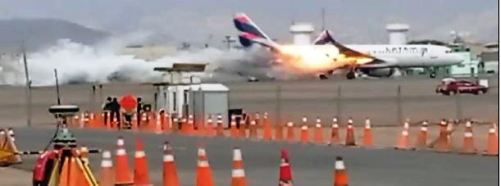
LATAM flight 2213,
an Airbus A320neo, CC-BHB, sustained substantial damage when it collided
with a firetruck during takeoff from runway 16 at Lima-Jorge Chаvez
International Airport (LIM), Peru. Flight LA2213 was taking off from
Lima’s main airport en route to the Peruvian city of Juliaca. There were no fatalities inside the plane,
buttwo firefighters inside the truck
sustained fatal injuries, a third firefighter sustained serious
injuries. Peru's health ministry
said that 20 passengers were being treated in a clinic, and at least
two were left in serious condition
after the incident. Three ARFF vehicles departed their station
on the west side of the runway. The first fire truck entered the active
runway 16 at taxiway B, around 1150 meters from the runway threshold. At that time flight LA2213 was accelerating
for takeoff. The no.2 (right-hand) engine of the aircraft impacted the
firetruck at a ground speed of around 127 kts. The right gear collapsed
and a fire erupted. The aircraft slewed to a stop on the runway, about
1600 m past the point of impact, and all 102 occupants evacuated. The airport operator, Lima Airport Partners
(LAP), stated that the firetrucks were part of a pre-planned response
time exercise. The air traffic control agency CORPAC had confirmed the
starting time of the exercise, 15:10 hours.
Probable Cause
Collision of the LATAM aircraft during the takeoff run with a rescue
vehicle from ARFF, which entered the runway without explicit
authorization from the CORPAC control tower while conducting a response
time exercise from the new aeronautical fire station at Jorge Chavez
International Airport. This chain of events was caused by a lack of
joint planning, poor coordination, and the failure to use standardized
communication and phraseology according to ICAO regulations.
Contributing Factors
1. Failure to conduct a post-1st ETR (Response
Time Exercise) briefing meeting between Lima Airport/ARFF and CORPAC to
identify errors, deficiencies, discrepancies, and material and
procedural shortcomings in the exercise's development. Such a meeting
could have allowed for an analysis and implementation of improvements in
all aspects, serving as a foundation for the optimal execution of the
2nd ETR.
2. CORPAC's acceptance without comments of Lima Airport's proposal to
conduct ETRs from partially implemented and testing-phase facilities
located in new airport areas that had not yet been officially handed
over to CORPAC's control.
3. The absence of meetings between Lima Airport's SMS and CORPAC's SMS
for hazard identification, risk management, and mitigation actions
inherent to the scheduling and execution of ETRs from the new airport
areas and facilities.
4. Failure to hold a joint meeting between Lima Airport and CORPAC to
plan the execution of the 2nd ETR, which would have provided
participating personnel with a clearer understanding of the concept and
details.
5. Inadequate instruction provided to ARFF and Tower Controllers'
personnel for familiarization with the location, designation, and
operational functioning of the new Aircraft Taxiways and Vehicle
Roadways.
6. The incorrect application of aeronautical communication principles
(clarity and precision) among those involved in the prior coordination
of the 2nd ETR led to a misinterpretation by CORPAC Tower Controllers
regarding its execution.
7. Tower Controllers failed to realize that by authorizing ARFF to
remove the Safety Cones, they were freeing up the only route (VSR4) for
the direct entry of the Rescue Vehicles convoy onto the runway.
8. ARFF's mistaken interpretation, thinking that the Tower's
confirmation for the start of the 2nd ETR also implied authorization to
enter the runway.
9. Aerodrome and Surface Tower Controllers were informed about the 2nd
ETR minutes before its execution, which did not allow them the capacity
to properly analyze the risks and prioritize air traffic management.
10. Failure to adequately use the standardized phraseology established
by ICAO for communications and exchanges between ARFF and the Tower
Controller during the execution of the 2nd ETR.


 Probable Cause